



 E-mail Alerts
Symposium of the "1+5" Think Tank Consortium on Shanghai's Five Centers Development —— DARPA and Beyond: Organizational Models for Mission-Oriented Innovation Successfully Held
2026-04-13
On the afternoon of April 7, Shanghai Institute for Science of Science (SISS), under the guidance of the General Office of the Leading Group for Accelerating Shanghai's Five Centers Development and the Shanghai Municipal Commission of Science and Technology, successfully hosted the special academic symposium titled DARPA and Beyond: Organizational Models for Mission-Oriented Innovation. The event was organized in accordance with the work plan of the Think Tank Consortium on Shanghai's Five Centers Developmentfollowing consultation with the leading institution, the Shanghai Academy of Development & Reform. Present at the event were leading officials from member institutions of the "1+5" Think Tank Consortium, including Chen Haipeng, Secretary of the CPC Committee of SISS, Zhu Xueyan, Deputy Director of SISS, Li Ling, Vice President of the Shanghai Academy of Development & Reform, Ye Donghui, Deputy Director of the Shanghai Municipal Economic Information Center, and Ni Jingwei, Vice Director of the Shanghai Research Center for Financial Stability and Development.
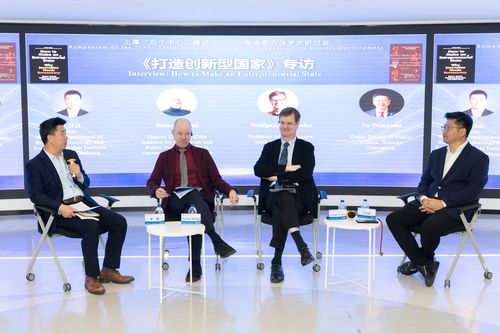
The symposium invited two authors of How to Make an Entrepreneurial State — Professor Rainer Kattel, Deputy Director of the Institute for Innovation and Public Purpose at University College London, and Professor Wolfgang Drechsler, Professor of Governance at Tallinn University of Technology, Estonia — as well as Professor Yu Wenxuan, Dean of the School of Public Affairs at Xiamen University, the translator of the book.
Also joining the in-depth exchanges were domestic scholars including Sui Jigang, Researcher and Director of the Institute of Innovation and Development Policy at the Institutes of Science and Development, Chinese Academy of Sciences, Professor Feng Kaidong from the School of Marxism at Tsinghua University, and Associate Professor Li Yin from the School of International Relations and Public Affairs at Fudan University. The symposium was chaired by Researcher Li Hui, Director of the Science, Technology and Society Research Department of SISS.
In his opening address, Chen Haipeng noted that as a key think tank in Shanghai, SISS has long conducted forward-looking and strategic research on new opportunities, challenges, logics and rules in building Shanghai (Yangtze River Delta) into an international science and innovation center. The institute strives to grasp the underlying logic and internal mechanism of scientific and technological innovation, explore research organization models that balance long-termism and strategic agility, avoid strategic missteps through dynamic optimization, and better seize strategic initiative. He expressed hope that the symposium would deepen understanding of more efficient organizational models for STI, supporting future decision-making consulting.
During the exclusive interview session, Researcher Li Hui held an in-depth dialogue with Professor Rainer Kattel, Professor Wolfgang Drechsler and Professor Yu Wenxuan, focusing on the core proposition of How to Make an Entrepreneurial State, covering successful and failed cases and implications for Shanghai to establish a more efficient innovation organization model.
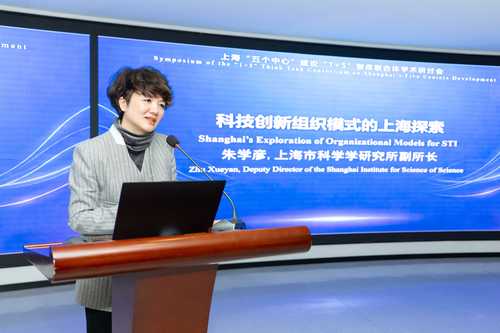
During the keynote speech session, Deputy Director Zhu Xueyan pointed out that the logic of scientific and technological innovation has undergone systematic changes in development paths, growth engines, value creation and talent cultivation. The three core dimensions for improving the innovation ecosystem and institutional support are "from 0 to 1" in basic research, "from 1 to 10" in technological breakthroughs, and "from 10 to 100" in industrial development. He stressed that the government should act as a top-level system designer, market failure regulator and public goods provider, and continuously foster an innovation-friendly ecosystem.
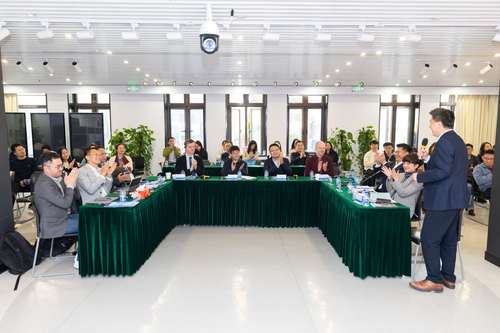
During the roundtable discussion, Vice President Li Ling, Director Sui Jigang, Professor Feng Kaidong and Associate Professor Li Yin delivered remarks in turn and exchanged views. They interacted with Professor Rainer Kattel and Professor Wolfgang Drechsler on the history, operation models, successful experiences and practical challenges of "DARPA-like" agencies across countries and sectors. The session featured active Q&A, incisive views and a vibrant atmosphere.
The successful symposium not only built a high-level platform for intellectual dialogue for the "1+5" Think Tank Consortium, but also deepened insights among domestic and foreign researchers into efficient innovation and an enabling government.
More than 80 leading officials and research backbones attended the event, including representatives from the "1+5" Think Tank Consortium — Shanghai Academy of Development & Reform, Shanghai Municipal Economic Information Center, Shanghai Development Research Center of Economy and Information, Shanghai Research Center for Financial Stability and Development, Shanghai Institute of Open Economy, Shanghai Shipping Exchange Research Institute (Preparatory), and Shanghai Institute for Science of Science (SISS) — as well as scholars from Fudan University, Xiamen University, the Institutes of Science and Development, Chinese Academy of Sciences, and other institutions.

 沪ICP备
11048235号-2
沪ICP备
11048235号-2
All copyright © Shanghai Institute for Science of Science
Address:4-5 F, 1634 Middle Huaihai Road, Xuhui District, Shanghai
Telephone:(021) 53300888 Fax:(021) 64381056 Email:siss@siss.sh.cn Zip code:200031
 沪公网安备 31010402001155号